Wednesday, February 22, 2023
Ash Wednesday
Pray in Secret
The gospel admonition to seek out a type of secret piety rather than a public one isn't a rejection of public worship for an eremitical life; it is the cautionary tale of one who looks for the wrong thing in their worship. Jesus notes that those who make a grand show of their piety receive what it is they are longing for: public adoration and acceptance. I suppose there is nothing inherently wrong with public adoration and acceptance if this is one's goal, but it is not the goal of true worship. True worship makes God the focus, not oneself. The concept of the word "worship" in English suggests ascribing worth due to someone or something. In a sense, our worship should express what we believe God is entitled to. What is God entitled to, if not the entirety of our being?
If we seek approval from others in our worship, Jesus says this is what we gain. God can only be honored in true worship in the secret of our hearts.
Saturday, December 10, 2022
Third Sunday of Advent
Should we look for another?”
The most striking part of today’s gospel is John’s disillusionment with Jesus, embodied in his question sent by messenger to Jesus: “Are you the one who is to come, or should we look for another?” Jesus’ reply, however, is even more striking. Instead of simply saying, “Yes, I am he,” he asks the messenger to report back to John what he has seen:
the lame walk,
lepers are cleansed,
the deaf hear,
the dead are raised,
and the poor have the good news proclaimed to them.”
Like many of us, John finds it difficult to believe that God’s justice does not involve some new political order, a new way of organizing society, yet another manifesto that, if we interpret it correctly and follow it faithfully, is guaranteed “heaven on earth”; that is not the kingdom of Heaven. The Kingdom is built around a way of being in this world but not being of this world.
It is telling the reaction of the crowd who encountered Jesus in John’s place. In the next section of the gospel, after Jesus declares, “…blessed is the one who takes no offense at me,” we see the crowd leaving and Jesus calling out to them:
Sunday, December 4, 2022
Second Sunday of Advent
Ready the Way of the Lord
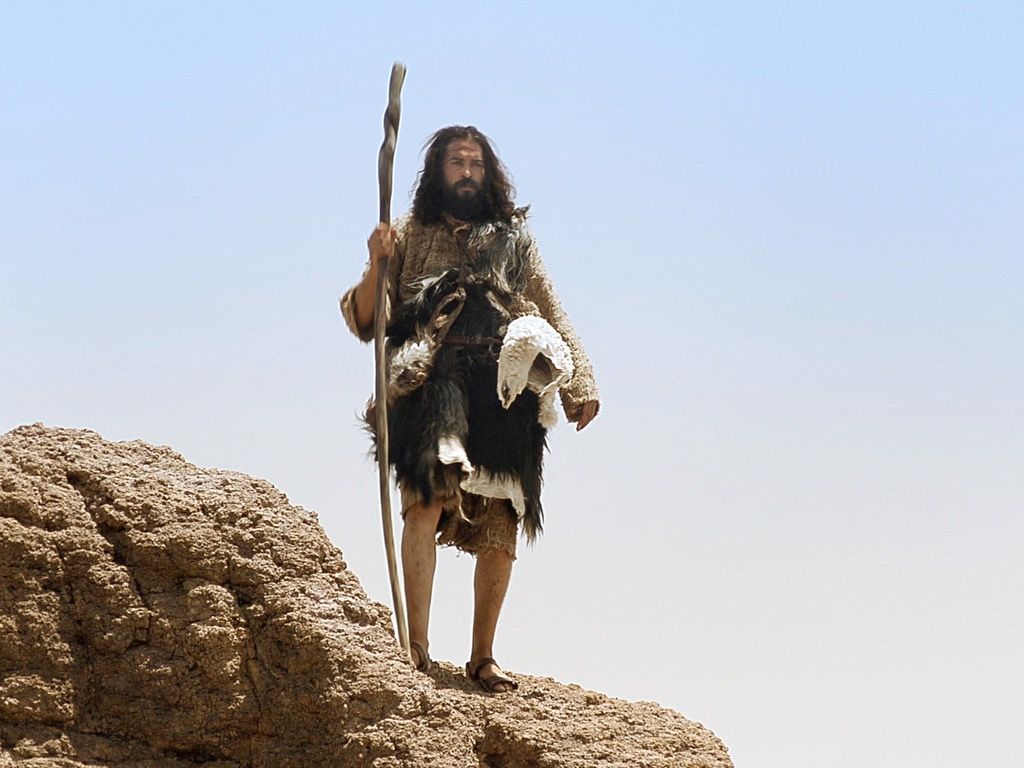
"His winnowing fan is in his hand; he will clear his threshing floor"(John the Baptist)Today, we shift from focusing on the “end times” to the other end of our journey, preparing for the coming of the Messiah! It is a preparation that harkens back to John the Baptist, who prepared the way by preaching repentance in the wilderness. Still, the preparation we live in today anticipates the revelation of God’s kingdom more perfectly.
Sunday, November 27, 2022
First Sunday of Advent
"Stay Awake!"
Sunday, November 20, 2022
Solemnity of Christ the King of the Universe
There is that famous line from Mel Brooks's movie History of the World: Part I, "It's good to be king!" Being king brings up beautiful imagery of elaborate court ritual, absolute authority, and feasting; sounds a lot like the institutional church! But Jesus' words to Pilate betray this image of opulence. When asked about his kingdom, Jesus replies "My kingdom does not belong to this world" (New American Bible). Another translation has it as "My kingdom is not of this world"(New International Version). The sense of Jesus' reply is that his kingdom is neither the kingdom of Rome nor the kingdom envisioned by the religious authorities; both groups lose.
The Solemnity of Christ the King that embraces Jesus as king is relatively new. It was established in 1925 to counter what the Church saw as an increasing tendency to worship human wisdom and power, which was loosely defined as modernism. Later, positioning the solemnity at the end of the Church's liturgical year in 1969 further enhanced its standing as the summit of Christ's rule and, implicitly, the Church as Christ's kingdom.
However, the songs and imagery associated with this celebration often blunt the irony of Christ as king. The common representation is a resurrected, non-bloody Jesus hovering (rather than being nailed) on the cross. The image of Christ as king is ironic because he is the king with a crown of thorns a procession of humiliation, and a knightly court of cowards. It seems as St. Paul writes in his letter to the Corinthians, "For the message of the cross is foolishness to those who are perishing, but to us who are being saved, it is the power of God."
The ironic image of Jesus as king nailed to the cross speaks of a different kind of power than the power of earthly kingdoms. In a general audience at the Vatican, Pope Benedict XVI suggests
"The power of God's kingdom as embodied by Jesus' death isn't exclusively revealed by the resurrection, although the saving power of God is most apparent here. The magnitude of God's love for His creation in self-sacrifice shows Christ's real power as king. "
The ultimate love is the love that sacrifices self for another. This is the real power that defines Christ's kingdom. This is why evil can never ultimately triumph over good; evil avoids self-sacrifice. Evil always seeks what is best for the self over and against the other. It destroys the community and ultimately destroys itself.
On the other hand, self-sacrificing love is the ultimate Christian act where one falls into the opened arms of Christ on the cross, trusting in the power of God's ability to bring life from death. Christ's kingdom is not of this world, but it is for this world. Nothing is more important than conforming to this likeness of Christ as King.
Saturday, October 22, 2022
Twentieth Sunday after Pentecost
Meister Eckhart, one of the church's great mystics, famously wrote that if you only had a single prayer to pray, "Thank you" would suffice.
This week, we continue
with the general theme of prayer with the righteous Pharisee as an exemplar of
how not to pray and the sinful "publican," or tax collector, as an
exemplar of how to pray. As usual, the unexpected is central to this
parable.
Jesus famously told his disciples what to pray for with the gift
of the Our Father; however, he didn't answer the question directly as to how to pray.
Today’s gospel is all about how to pray.
The Pharisee's prayer was more horizontal than vertical; his prayer was self-congratulatory for not being like his sinful neighbors. His prayer was from an island of self-righteousness.
O God, I thank you that
I am not like the rest of humanity --
greedy, dishonest, adulterous -- or even like this tax collector.
I fast twice a week, and I pay tithes on my whole income.
His gratitude springs
from "not being like the rest of humanity," it begins in
separation, focusing on his side-view of a sinner. And the tax
collector was a sinner. Let's not make him into some
noble hero. Tax collectors were famous sellouts in Jesus' time.
They were Jews who profited from their association with the occupying Romans and were
allowed to keep whatever they could collect above what was required from their fellow
Jews. They even had the power to have non-compliant Jews arrested. As with most
people invested with such power, the power was abused, and these folks were
famously despised.
The Pharisees were a group of religious scholars trying to bring the average person hope by helping them live righteous lives by putting the Law into practice. The Pharisee's pride grew from
being socially, educationally, and religiously set apart from the people he was
called to lead. There is a lesson in it for me as a priest and anyone
with temporal authority within the Church. I can imagine such pride was
incremental and crept in as he appropriated each compliment and praise received
from the people he helped, growing like a wildfire until it consumed him in the
deception that what they adored was him rather than God's gift to him.
The tax collector had no such delusions.
The tax collector's prayer was vertical; off at a distance and prostrated, he
couldn't even see or hear the Pharisee. The tax collector's sins were too
painful for him to list. He simply prays, "Have mercy on me, a
sinner!" Scripture says he went away justified; God forgave his sins not
because he was righteous but because he prayed from his poverty of spirit.
The Pharisee prayed from what he considered his great possessions: his
righteousness. Like the widow only putting in a mite for the Temple collection,
she gives all she has. She isn't donating a small portion of her wealth;
Jesus observes in that parable that "she gave from her poverty."
We must pray from our poverty because this is our state in relation to
God. We have nothing to stand on but clay feet, but it is the same clay
God formed; it is human clay, and it is the source of true humility and genuine
gratitude because God has redeemed it in Christ.
When we pray from our poverty, we tap into the riches that God has given us. Time and time again, God's grace seeks out the humble, the lowly, and the dispossessed. Throughout salvation history, God visits the least regarded and comes to visit and give great comfort. There is something in the nature of God that desires such intimacy as that of a mother caring for her sick child. We don't need to be great and notorious sinners to attract God's love; it is there before we ask. God is in love with humanity, and the less we stand human before God, the more distorted our understanding of the image of God within us.
The Oscar Wilde quotation, "We are all in the gutter, but some of us are looking at the stars," comes to mind. Our prayer is always a cry for mercy when we begin with being grateful for having the vision of the stars from the gutter.